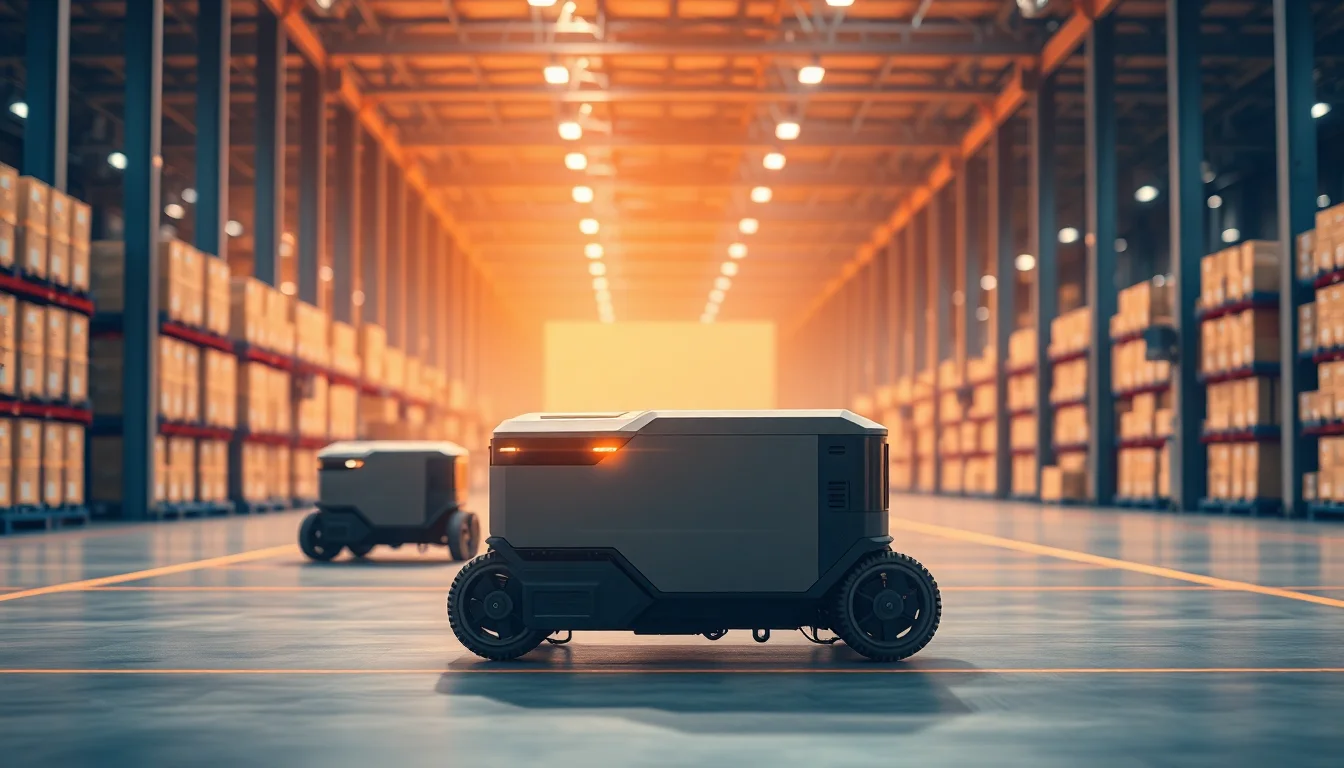
Symbotic’s latest operating numbers are notable not because they are large, but because they are operationally legible. In 2025, the company says its autonomous mobile robots traveled more than 200 million miles and processed 2.23 billion cases across customer distribution centers. That puts the business in a different category from the still-common warehouse AI pilot: this is no longer a system being tested for viability, but one being exercised at a scale that forces hard questions about reliability, fleet control, data plumbing, and cost structure.
The distinction matters. In physical AI, volume is not just a vanity metric. Miles traveled and cases handled are proxies for how often a system encounters edge conditions, how much telemetry it generates, how consistently its scheduling stack performs under load, and how much trust operators can place in it when the warehouse is busy, the SKU mix shifts, or a downstream conveyor is late. A platform that can keep moving product while increasing per-bot miles by more than 20% and cases handled by 9% per day, as Symbotic reported, is demonstrating something customers care about more than promises of autonomy: repeatable throughput.
What 2.23 billion cases really says about warehouse AI
At this scale, the milestone is less about absolute totals than about what those totals imply about deployment maturity. A warehouse automation vendor can show a nice demo, a controlled pilot, or a single-site rollout and still avoid the harder operational problems. But 2.23 billion processed cases means the system has been embedded in production environments long enough to accumulate a meaningful operational history across inbound and outbound flows.
That history becomes a baseline for procurement. Customers evaluating a large deployment are not just asking whether robots can move totes or cases. They are asking whether the system can sustain uptime across shifts, absorb seasonal surges, and keep error rates low enough that the manual exception-handling burden does not erase the efficiency gains. Once a fleet has logged 200 million miles, the conversation shifts from “Can it work?” to “How does it behave over time, and what does it cost to keep it behaving that way?”
That is the key change in deployment economics. Pilot economics are dominated by installation, integration, and skepticism. Platform economics are dominated by utilization, serviceability, and the cost of maintaining throughput. A vendor that can point to billions of cases processed is not proving that all warehouses will benefit equally, but it is proving that the underlying operating model has escaped the lab.
Scale changes the engineering stack, not just the sales pitch
The technical implications of this kind of scale are easy to underestimate. Warehouse robotics at production volume is not a single AI model sitting on a server. It is an edge-heavy system that has to make low-latency decisions near the machines, coordinate movement across a fleet, and continuously ingest telemetry about position, load state, exceptions, congestion, and hardware health.
That means edge inference becomes a first-class constraint. The system cannot rely on round-trips to a central cloud service for every movement decision. Latency, connectivity, and local safety all require computation close to the robot, while higher-level coordination still has to orchestrate route assignment, traffic control, and task prioritization across the fleet. The bigger the fleet, the more important the orchestration layer becomes. A warehouse full of autonomous mobile robots is not simply a collection of independent agents; it is a distributed control problem with collision avoidance, scheduling, fault recovery, and throughput optimization all happening at once.
Telemetry is the connective tissue. The value of the 200 million miles figure is not just that the robots moved a lot; it is that every mile likely produced data about route efficiency, bottlenecks, dead zones, maintenance intervals, and edge-case behavior. At scale, that telemetry feeds model updates, control-policy tuning, and operational dashboards that customers use to understand whether the system is actually improving or merely staying busy.
That creates a hard requirement for model governance. If a vendor is pushing changes across a live fleet, it needs version control, staged rollout, rollback logic, and monitoring that can distinguish between a true performance improvement and a regression hidden inside aggregate throughput. In physical AI, a bad update is not a disappointing benchmark score. It is a robot that misses a handoff, blocks a lane, or forces a manual intervention that ripples through the warehouse.
Safety is the non-negotiable layer underneath all of this. The more miles a fleet travels, the more important it becomes to prove fault tolerance, safe-stop behavior, exception handling, and compliance with site-specific operating rules. At warehouse scale, safety is not merely about collision avoidance. It is about how the system behaves when sensors degrade, maps drift, humans enter constrained areas, or integrations with warehouse management systems produce conflicting instructions. The more autonomous the platform becomes, the more a customer will want evidence that the vendor’s safety case extends beyond a demo floor.
Why the milestone changes how customers buy
The business implication of Symbotic’s milestone is that physical AI is increasingly being bought as a platform service, not as a one-off automation purchase.
That shift matters because the economics of a fleet built around throughput are different from the economics of a capital project. The buyer is not just comparing the sticker price of a machine against headcount. It is comparing a service-like operating model against the full burden of integration, maintenance, training, uptime management, and exception handling. The more mature the platform, the easier it becomes to justify ongoing Opex tied to sustained utilization rather than a single capex event that still requires significant internal support.
Symbotic’s numbers support that argument. When a system has processed 2.23 billion cases and traveled 200 million miles, customers can ask for evidence-based expectations around throughput and time-to-value instead of accepting speculative ROI claims. But the caution is important: the economics will still depend on facility layout, SKU behavior, labor constraints, and how deeply the automation stack has to integrate with existing warehouse systems. A strong platform story does not eliminate integration complexity; it standardizes more of it.
That is also where market positioning changes. Vendors with enough production history can argue that they are not just selling robots, but operating systems for warehouse movement. In a crowded physical AI market, that matters. Customers increasingly want a supplier that can manage the fleet lifecycle, deliver software updates, support telemetry-driven optimization, and absorb operational complexity over time. The milestone reinforces that Symbotic is positioning itself around repeatable service delivery rather than isolated deployments.
The risks get sharper as the fleet grows
Scale also exposes the parts of the stack that do not show up in polished case studies. Once deployments become fleet-wide, cybersecurity becomes a real operational concern. Robots, control systems, site networks, and management software all become part of the attack surface. The same data and orchestration systems that enable efficiency can also become points of failure if access controls, segmentation, and update workflows are not tight.
Data governance is another issue. A system generating telemetry at this scale will collect a large amount of operational data that may be useful for tuning, support, and product improvement. Customers, however, will care about where that data lives, who can access it, how long it is retained, and whether it can be used across sites or shared with adjacent systems. Those are not abstract policy questions. They shape procurement, legal review, and partner selection.
There is also the problem of interoperability. Warehouse environments rarely begin with a clean slate. They are already populated with WMS, WCS, ERP, conveyor controls, scanners, and a mix of vendor-specific workflows. As fleets scale, the quality of integration matters as much as the quality of the robot. A technically elegant autonomy stack can still underperform if it cannot cooperate cleanly with the rest of the warehouse.
And then there is model drift. A warehouse is a changing environment: inventories shift, slotting changes, labor patterns move, and seasonal demand alters traffic. A fleet that performs well today still has to prove that it can stay aligned as the operational environment evolves. That is where continuous telemetry and controlled updates become essential rather than optional.
What technical teams should take from this
For engineers, product leaders, and procurement teams evaluating physical AI, Symbotic’s milestone is a reminder to benchmark the whole system, not just the robot.
The right questions are practical:
- How much edge compute is required to support real-time decisions at your site density?
- What telemetry is captured, at what granularity, and how is it used for safety, tuning, and support?
- How are fleet-wide software updates staged, validated, and rolled back?
- What does the exception path look like when a robot, sensor, or integration fails?
- How much of the expected ROI survives after integration, maintenance, and safety oversight are fully priced in?
Those questions are where the category is maturing. The headline numbers from Symbotic do not prove that every warehouse should automate in the same way. They do show that some warehouse robotics platforms are now operating at a scale where deployment economics, not just technical feasibility, drive the buying decision.
That is an important marker for physical AI. The market is moving from demonstrations of autonomy toward proof of sustained operations. In logistics, that is the difference between an interesting product and an infrastructure layer.


