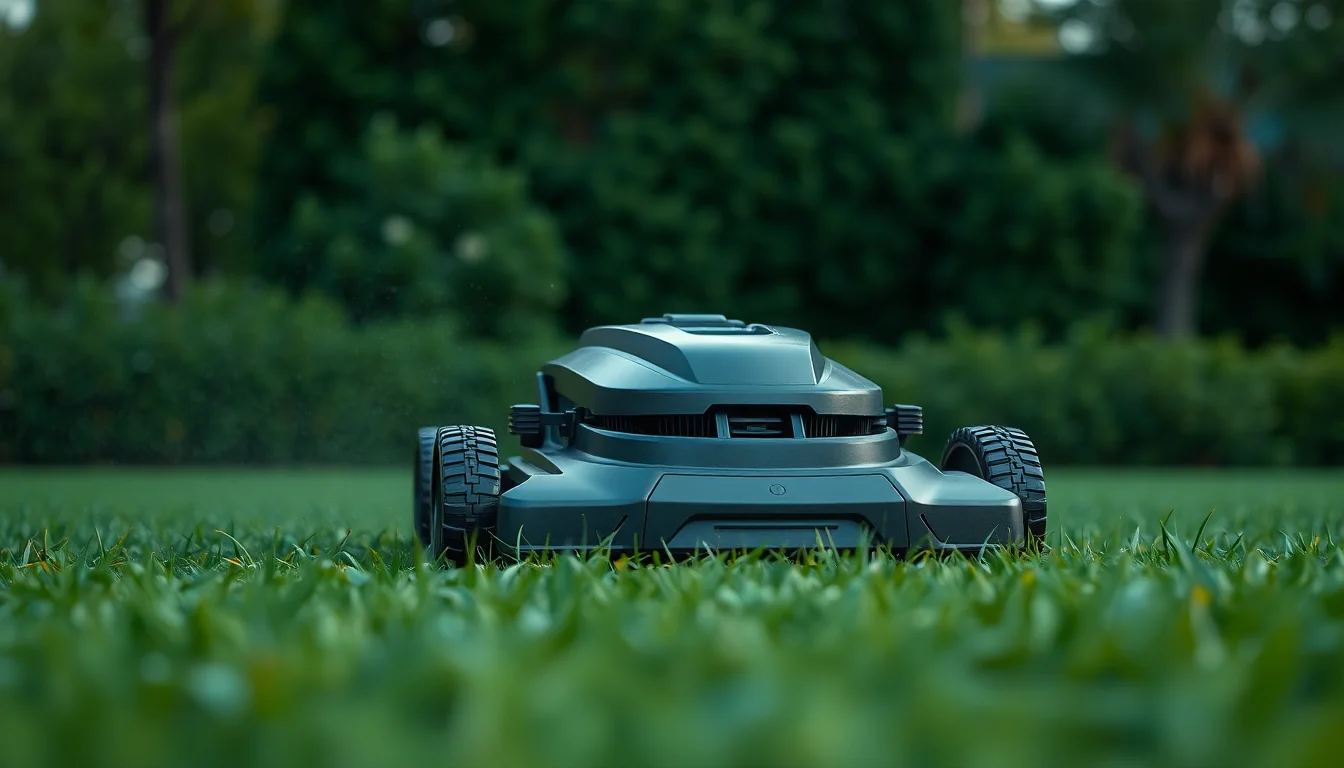
Boundary wires used to be the defining constraint of robotic lawn mowing. They solved a hard problem—keeping a machine inside an understood work area—with a brutally simple method: physically mark the perimeter and let the mower follow it. That architecture made sense when sensing, compute, and localization were too weak to trust anything more ambitious.
That premise is changing. The newer wave of robotic lawn mowers is moving toward boundary-free navigation, where the mower infers its operating area from positioning, perception, and mapping rather than from buried wire. The appeal is obvious: faster setup, fewer installation errors, more flexible yard changes, and a product that feels much closer to a consumer appliance than a weekend project. But the technical shift is more consequential than the marketing language suggests. It replaces a largely deterministic control boundary with a software stack that must continuously locate itself, understand the scene, and decide what counts as safe terrain.
That is why this transition matters now. The industry is not simply swapping one location marker for another. It is rearchitecting the product from rule-based automation toward spatially intelligent autonomy. In practical terms, that means the stack has to perform reliably across uneven lighting, tree cover, cluttered yards, seasonal changes, and the messiness of real-world deployment. The same qualities that make boundary-free systems attractive also create new failure modes.
The technical stack: RTK, AI vision, and SLAM in one loop
The boundary-free approach typically rests on three capabilities that work together rather than independently.
RTK, or real-time kinematic positioning, provides the global anchor. In mowing applications, that usually means using satellite positioning with correction signals to improve location accuracy far beyond standard GPS. The point is not just to know where the mower is, but to know it closely enough that the machine can follow a planned route, maintain coverage, and remain within a virtual perimeter. RTK is the layer that replaces the fence with coordinates.
But RTK alone is not enough. Satellite positioning can be degraded by trees, structures, signal obstruction, and local environmental conditions. That is where SLAM enters. Simultaneous localization and mapping lets the mower build and update a live model of nearby space while also estimating its own position within that map. In other words, RTK can provide the broader frame of reference, while SLAM fills in the local geometry and helps the machine keep operating when external positioning becomes less dependable.
AI vision adds another layer: object recognition and scene interpretation. A mower does not only need to know where it is; it needs to know what is in front of it. Vision systems can identify obstacles, distinguish traversable from non-traversable areas, and in some cases interpret semantic cues that improve path planning. That matters because lawns are not empty test fields. They contain toys, pets, garden furniture, flower beds, slopes, edges, and temporary clutter. A boundary-free mower has to respond to all of that without the safety net of a buried wire.
The important point is that these systems are not parallel features so much as a fused control loop. RTK may establish the coarse location, SLAM may refine it in the local environment, and vision may decide whether the next patch of grass is actually safe to cut. The orchestration becomes the bottleneck. A system that is strong in one mode but brittle in another will still fail in the field. That is why the real product challenge is not the presence of RTK, vision, or SLAM individually. It is how well the firmware, sensor fusion, calibration, and fallback logic work together under conditions that vary minute by minute.
This is also where boundary-free systems differ from traditional boundary-wire machines in a way that goes beyond convenience. Wire-based mowers outsource the definition of the work area to installation time. Once the loop is placed correctly, runtime complexity is relatively low. Boundary-free systems, by contrast, carry more of that burden at runtime. They need to construct and maintain the operating context continuously.
Why the shift matters beyond installation
The strongest argument for boundary-free mowing is the elimination of installation friction. Boundary wires are reliable once installed, but they are cumbersome. They require planning, physical placement, troubleshooting, and in some cases rework when the yard changes. That creates a high-friction first-use experience and can make the product feel less like a consumer device and more like a project.
Boundary-free systems promise a better setup story. If the machine can map the yard and establish virtual boundaries without burying wire, the experience becomes more like onboarding software: configure, verify, and let the system learn. That does not just improve convenience. It changes who the product is for, how often it can be redeployed, and how easily it can adapt to changing properties or multi-zone mowing.
It also changes what buyers are purchasing. With wire systems, the core value proposition is dependable perimeter enforcement. With boundary-free systems, the value proposition becomes autonomous interpretation of space. That is a meaningful shift in product category. The mower is no longer only a scheduled actuator; it is a perception-driven robot.
Deployment, safety, and standards: the new bottlenecks
Once setup friction drops, the hard problems move elsewhere.
The first is calibration. A boundary-free mower has to align its internal model with the physical yard accurately enough to avoid drift, missed patches, and boundary violations. RTK correction quality, local mapping stability, and camera or sensor calibration all affect that outcome. In practice, robustness depends on how well the system handles transitions: under trees, near walls, around reflective surfaces, or in areas where GPS-quality positioning is inconsistent.
The second is continuous localization. A mower can start with a good map and still fail if it loses positional confidence during operation. The system must detect uncertainty and respond conservatively. That can mean slowing down, re-localizing, stopping, or defaulting to safer behavior. The need for these fallback behaviors is one reason boundary-free mowing is not just a software update on top of existing hardware. It requires a safety architecture that assumes perception will sometimes be imperfect.
The third is obstacle and edge safety. AI vision can improve awareness, but it is not a magic shield. Perception models can struggle with lighting variation, partially occluded objects, unusual shapes, or rapidly changing environments. That creates a need for layered safety design: redundant sensing where appropriate, conservative motion planning, and clear operational limits. A mower must not only be accurate; it must fail safely.
Standards and regulation become more important as the autonomy level rises. The evidence in the market points to a transition, but not to a solved governance model. Consumer robots that move around people, pets, driveways, and public-adjacent spaces face a different risk profile than wire-contained systems. That means certification, functional safety expectations, and operational guidance are likely to matter more, not less, as boundary-free systems scale. The commercial rollout will depend partly on how quickly standards catch up with the capabilities being shipped.
There is a subtle tradeoff here. The boundary-wire system looks old-fashioned, but its constraints are legible. The wire is a physical safety boundary that is easy to reason about. The boundary-free system is more flexible, but its safety envelope is distributed across software, sensors, and inference. The product may feel simpler to the buyer and more complex to the engineer at the same time.
Market positioning and the roadmap forward
The competitive implications are straightforward in one sense and difficult in another. If boundary-free navigation becomes the default expectation, vendors that cannot offer reliable setup, robust localization, and safe autonomous behavior will be pushed toward the low end of the market or into niche use cases. The market will not reward autonomy claims on their own; it will reward systems that actually reduce ownership friction without shifting the burden onto the customer.
That means roadmaps will likely tilt toward software integration and ecosystem maturity. Open interfaces matter because these systems depend on multiple layers working together: positioning services, mapping pipelines, perception models, app onboarding, and safety controls. Vendors that can coordinate those layers cleanly will have an advantage over those shipping isolated features that do not compose well in the field.
Partnerships are likely to become more important as well. Boundary-free mowing is not just a mower problem. It touches satellite correction infrastructure, mapping software, sensor suppliers, and service workflows for installation and support. The more end-to-end the promise becomes, the more brittle the stack becomes if any single layer fails to meet spec. Vendors will need ecosystems that can support calibration, diagnostics, updates, and exception handling, not just hardware assembly.
For product strategy, the major implication is that roadmaps will increasingly be defined by autonomy confidence rather than motor performance alone. Cutting width, battery life, and terrain handling still matter, but they are table stakes if the core navigation experience is unstable. The differentiator becomes whether the system can deliver a dependable boundary-free experience across different yards without requiring expert intervention.
That is also where the category will separate early adopters from laggards. Early adopters may tolerate occasional setup complexity or the occasional localization edge case in exchange for wire-free convenience. Mainstream buyers will not. They will expect a product that works out of the box, handles ordinary yard variability, and degrades safely when it cannot. Vendors that can reconcile those expectations with the realities of RTK, vision, and SLAM will define the next phase of the market.
The larger lesson is that boundary-free navigation is not just a feature trend. It is a systems transition. Traditional boundary-wire mowers encoded the work area in hardware. The new generation encodes it in software, sensors, and continuously updated spatial models. That unlocks a more flexible product, but it also raises the bar on calibration, fallback behavior, and safety assurance. In robotic lawn mowing, the wire is not just being removed. The whole architecture around what counts as a yard is being rewritten.


